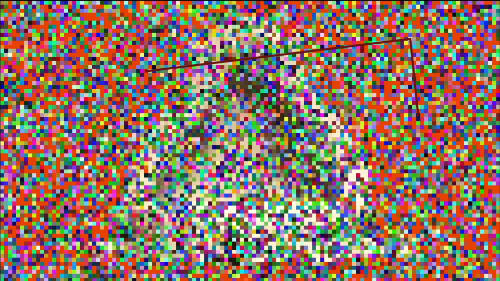
Pixels, the smallest units of visual information,
are randomly distributed. Then, the original image is reconstructed
using the binary code of these lower-level units.
Description:
The Digital Deconstruction and Reconstruction of Marcel Duchamp
This video is the artist Kenji Kojima's new media series, "After Marcel Duchamp." In an era where all visual information is stored and processed in binary format, this project presents binary code not merely as a technological foundation but as a fundamental artistic medium. Instead of imitating or superficially appropriating historical styles, Kojima aims to deconstruct the structural foundations of the image itself. He positions binary logic as an ideological and material connection to the next stage in art history.
In the 21st century, the essential material of an image is no longer pigment or canvas, but data structured by binary logic. While contemporary AI systems generate images by recombining vast archives of existing visual data, Kojima takes a different approach. Instead of assembling images using digital applications or generative AI, he decomposes visual information into binary units—the most basic elements of computation—and explores how images are constructed at that level. This approach shifts attention from representation to structure, from visual appearance to information architecture.
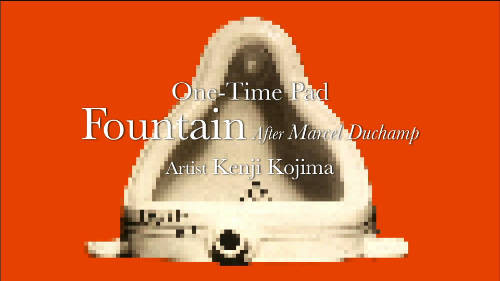
This project visualizes this exploration through a process of fragmentation and reconstruction. Kojima randomly scatters image pixels across the screen, dispersing color information before restoring the original data in binary units. Since each pixel is composed of multiple binary values, such as RGBA, the image does not appear instantaneously. Instead, it gradually appears as a fragmented, glitch-like animation. The restoration is intentionally delayed until the binary data is completely replaced. In this way, the work defies the convention of instant recognition common to many digital images and instead forces the viewer to experience the passage of time measured in binary units.
This temporal dimension is the core of the work. Instead of presenting a finished image optimized for immediate comprehension, the video reveals the "process of information construction" itself. The viewer witnesses the transformation of scattered data into a coherent form and participates in the time it takes for logical consistency to emerge from chaos. Time is thus visualized as an information process.
In this video, Kojima applies this technique to Marcel Duchamp's paintings "Nude Descending a Staircase," "The Large Glass," and "Fountain (One-Time Pad)." Simultaneously, a sound component transforms the visual data into music. The red, green, and blue values of each pixel are converted into a 12-tone scale and played as a MIDI piano piece. This way, both image and sound are directly derived from digital data structures, reinforcing the project's focus on binary as a material.
The conceptual origins of this approach date back to Kojima's previous project, "Split/Merge AudioVisual" (c. 2013), and were further developed in response to the rapid development of artificial intelligence in the visual arts, around 2023. While AI primarily recombines existing images, Kojima explores underutilized data structures that could potentially mediate human-machine communication. One key inspiration was the logic of one-time pad encryption. Drawing on the blending of colors in Georges Seurat's pointillist paintings, he separated the painting's color data into two groups: encrypted information and a decryption key. While the encryption function produces a logically valid result, the human eye initially perceives it as a uniform or indecipherable color field. Only through proper binarization can a recognizable image emerge again. This technique is applied in "Fountain (One-Time Pad)."
This experience is based on three fundamental principles. First, it rejects immediacy. Images are not displayed instantaneously but are temporarily held. Second, it embraces fragmentation. Scattered pixels across the screen create glitch-like transitions instead of smooth restoration. Third, it strives for logical completeness. Images can only be reconstructed once the consistency of binarization is achieved. Through this process, viewers encounter the binary logical structure underlying contemporary visual culture—not as an abstract concept but as a perceptible temporal event.
Ultimately, by observing time in binary units, this project proposes a novel digital aesthetic rooted in data itself. It fosters a deeper awareness of the hidden constructions behind information and positions binary logic as a primary artistic material in the era of artificial intelligence.
Kenji Kojima's Biography:
Kenji Kojima was born in Japan. He moved to New York in 1980 and began his artistic career. For the first 10 years in New York City, he painted contemporary egg tempera paintings using medieval art materials and techniques. He was strongly attracted to contemporary art but felt stuck in the future of modern civilization and art with excessive material value. He tried to experience the history of the creation of the European concept of art through actual materials and techniques, that is, the history of art that is not written in literature. He was particularly interested in the basic materials of painting, such as ground, pigment, and medium, rather than the visual theme. He noticed that as society developed, people's minds expanded, materials and tools advanced, and the visual arts changed. Citibank, Hess Oil, and others have collected his egg tempera paintings.
The personal computer improved rapidly during the 1980s. He felt more comfortable with computer art than paintings. Ecologically, he had felt guilty about wasting materials in the name of art. Working on the computer was clean, did not waste material, and made him feel lighter. In the early 1990s, he moved his artwork into the digital arts. He was particularly interested in developing interactive artworks. His early digital works were archived at the New Museum - Rhizome, New York. He studied computer programming himself. In 2007, he developed the computer software "RGB MusicLab" and created an interdisciplinary artwork that explores the relationship between images and music. He developed interactive software for his art but soon ran into a big problem. the software would not run on the new operating systems. He shot the artwork to video while the software ran on the operating system. He started making videos, not only about programming art but also about ecological issues in art by shooting videos. His digital art series has been shown at media art festivals worldwide, including Europe, South America, the Middle East, Asia, and the USA.
After COVID-19, he could not go out to shoot a video, but he found numerous archival artworks online. He launched a new series titled "The Musical Interpretation of Paintings" which transforms classical image data such as paintings, photographs, and films into music. Artist Kojima believes that the sensory organs construct the world by extracting only certain components from the chaos, such as visual and auditory information, like a filter. So we create our world with the "key" of the sensory organs as if we were deciphering a code. In 2023, "Bitwise Splitting and Merging of Pixels" began with the self-question, "With the development of generative AI, can we create visual art that is not an assemblage of past visual data? Currently, all media is recorded in binary form. This fact leads to the manipulation of color pixels using bitwise operations. He developed encryption and decryption projects based on classic paintings, including The Da Vinci Code, as well as a binary interpretation of Van Gogh's and Gauguin's time in Arles. He also started a participatory video art project called "This Planet Is Our Home," which focuses on the Anthropocene and ecology. Kenji Kojima Resume
Digital Art Exhibitions:
the USA: 2026-2025 The Wrong Biennale, Online & Offline / 2024 OtoZono at HEART, New York. / 2024 the New Media Art Space at Baruch College, New York. / 2024 All Street, New York / 2023, 2020 Torrance Art Museum, Los Angeles, USA. / 2023 THE ELASTIC MIND, BROWARD College, Weston, Florida. / 2023 SOJOURNER, New York, NY. / 2022 Asian American International Film Festival, New York, NY. / 2012, 2016 Light Year, Brooklyn, New York. / 2021 UNCG International Sustainability Shorts Film Competition, UNC Greensboro, NC, USA. / 2019 The Harold B. Lemmerman Gallery, New jersey City University, Jersey City, NJ. / 2019, 2016, 2015 Williamsburg Art & Historical Center, New York, NY. / 2018 The Exchange, Bloomsburg, PA. 2018 WhiteBox, New York, NY. / 2015 ACM SIGGRAPH Digital Arts Community. / 2014 MediaNoche, New York, NY. / 2008 AC Institute, New York, NY.
Europe: 2025 Internationales Digitalkunst Festival 2025, Stuttgart, Germany / 2025 ON SCREEN 2025, Vienna, Austria / 2025 OPEN NIGHTS FESTIVAL Vol.10, Thessaly and Lárisa, Greece / 2025 Selected in the TAA (The Art Association) TAA Open Call Video Competition 2025 Final Candidates (2024 YouTube Exhibition), Geneva, Swiss / 2024 Profusion of Colors, A.E. Corner, Galleria di Tirano, Viale Italia / 2024 Summer of Anthropocene, The New Museum of Networked Art, Cologne, Germany / 2024 DIGITAL VIDEO ART INTERNATIONAL STREAMING FESTIVAL 'The films of the Official Selection 2024', Season 3 & 5, Vienna, Austria / 2024 Technocene Berlin Templehof, Germany. / 2024 Open Media Art, Košice, Slovakia / 2025, 2024, 2023, 2022, 2020, 2019 Ie Rencontres Internationales Traverse, Toulouse, France. / 2021 FEX comtemporary media art, Cologne, Germany. / 2020 Institut für Alles Mögliche, Stützpunkt Teufelsberg, Belrin, Germany. / 2019 The festival BINNAR, Vila Nova de Famalicão, Portugal. / 2019 MADATAC X New Media Arts Festival, Madrid, Spain. / 2018 Athens Digital Arts Festival, Athen, Greece. / 2018 Mitte Media Festival, Berlin, Germany. / 2017 Simultan Festival, Timisoara, Romania. / 2016 Simultan Festival, Timisoara, Romania. / 2016 Brave New World Beyond the Wall, Berlin, Germany. / 2015, 2013 ESPACIO ENTER, Tenerife, Canary Islands, Spain. / 2014 BRAVE NEW WORLD, Berlin, Germany. / 2011 Jyväskylä Art Museum, Jyväskylä, Finland. / 2010 PROCESS Festival, Berlin, Germany. / 2009 RE-NEW Digital Art Festival, Copenhagen, Denmark. / 2002 Free Manifest, Frankfurt am Main, Germany.
Brazil: 2025, 2023, 2022, 2020, 2016, 2012, 2011, 2010 FILE (Electronic Language International Festival) São Paulo, Brazil. / 2012 FILE RIO, Rio de Janeiro, Brazil. / 2010 FAD (Festival de Arte Digital), Belo Horizonte, Brazil.
the Middle East: 2026 The Ras Al Khaimah Art Festival Biennale, United Arab Emirates / 2020, 2012 Istanbul Contemporary Art Museum, Turkey. / 2020, 2019 Paadmaan Video Event, Isfahan, Iran.
Asia: 2021 Thailand New Music and Arts Symposium, Bangkok, Thailand. / 2020 the 150th Anniversary Gandhi Event, Kolkata, India. / 2019 Capital Normal University College of Cape Cod, Beijing, China & China University of Mining
and Technology Yinchuan College, Yinchuan, China. / 2018 Gunung Sunda Festival, Sukabumi, West Java, Indonesia. / 2016 CeC 2016, North-Eastern Hill University, Shillong, Meghalaya, India. / 2010 Contemporary International New Media Art Invitational, Wuhan University of Technology, China.
The videos are free to share
and download without permission.
You can show it without permission.
If you appreciate the video as art, you can donate any amount from $1.00 to the artist. Even if you don't approve, you can keep it.
However, as you've already determined, it lacks artistic value.