Show: Japanese / 日本語
Hide: Japanese / 日本語
現在、あらゆる情報はバイナリ形式で保存されています。本プロジェクトは、ゴッホの作品タイトルに見られる「After(~に倣って/d'après)」という概念を用い、画像を解体・再構築することで、新たな美意識の発見を目指すものです。これは単なる模倣や様式的な引用にとどまらず、画像が持つ根底の構造そのものを解き明かそうとする試みです。アーティストの小島は、バイナリコードを、美術史の次なるフェーズへと繋がる思想的な架け橋として活用しようとしています。現在、AIは過去の画像の「寄せ集め(アサンブラージュ)」として画像を生成しています。21世紀における画像の根本的な素材は、絵具やメディウムではなく、むしろバイナリによる論理構造そのものなのです。AIのように既存の画像を寄せ集めたり、デジタルブラシで描画したりするのではなく、小島は視覚情報をコンピューティングの最も基礎的な単位である「バイナリ」へと分解しようと試みます。これは、生成AIとの対話において人間が通常意識することのない概念ですが、小島はこの手法を通じて情報がいかに構造化されているかを観察し、次なるステップへの道筋を切り拓こうとしています。
アーチストの小島は、人間の感覚器官を一種の「フィルター」として捉えています。感覚器官は、私たちを取り巻く混沌とした世界の中から、視覚や聴覚といった特定の要素を抽出し、それらを構築しているのだと考えます。私たちは、感覚器官という名のアルゴリズム的フィルターを介して、この混沌とした世界を知覚し、構築しているのです。
本プロジェクトは、デジタルアートの可視化という領域において、「知覚」と「構造」という概念を深く掘り下げたものです。その思想を表現するために、バイナリコードとアルゴリズムが用いられています。物質からデータへと移行しつつある現代において、最も劇的な変革の一つが進行中ですが、この変革は、バイナリを芸術表現における根本的な「媒体(メディア)」として捉え直すことの必要性を私たちに突きつけています。小島は、画像が持つピクセルをランダムに散乱させ、あらゆる色彩を拡散させると同時に、元のデータをバイナリ単位へと置き換えていきます。ピクセルは4つのバイナリ値によって構成されているため、画像は次第に断片化し、3次元のRGBキューブ(立方体)の中に点や線として描画されていきます。通常、コンピュータ画像は人間が即座に認識できるようプログラミングされていますが、本プロジェクトはそれとは異なり、鑑賞者に対して「バイナリ単位で刻まれる時間の経過」を直視することを促します。本プロジェクトの映像作品は、前述の手法を用いて、ウィリアム・ターナーの絵画作品を分析・再構築したものです。
映像の背景に流れるサウンドは、各絵画のピクセルが持つ赤・緑・青(RGB)の値を「12音階」へと変換し、それをMIDIピアノで演奏することで制作されました。本プロジェクトは、これらの作品を現代のバイナリシステムという枠組みの中で解体・再構築し、改めて検証し直すことを目的としています。そして、美術史における全く新しい美意識の確立に向け、その先駆者となることを目指しているのです。
Hide: Japanese / 日本語
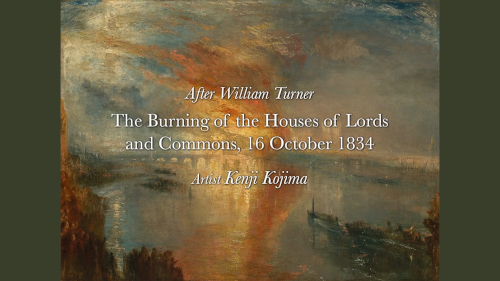
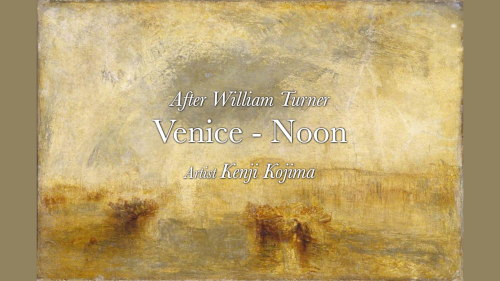
Project: After William Turner
Currently, all information is stored in binary format. This project aims to discover a new aesthetic sense by deconstructing and reconstructing images using the concept of "After (d'après)" found in Van Gogh's titles. This goes beyond mere imitation or stylistic allusion, seeking to break down the underlying structure of the images. Artist Kojima seeks to use binary code as an ideological link to the next phase of art history. AI currently generates images as an assemblage of previous images. The fundamental material of 21st-century images is not pigments and mediums, but rather a binary logical structure. Instead of creating images through assemblage or painting with a digital brush, as AI does, Kojima attempts to break down visual information into binary, the most basic unit of computing—a concept not typically used for human communication with generative AI—and observes how information is structured, paving the way for the next step.
Kojima believes that our human sensory organs act like filters, extracting specific elements like sight and hearing from the chaotic world around us and constructing them. We perceive and construct this chaotic world using algorithmic filters called our sensory organs.
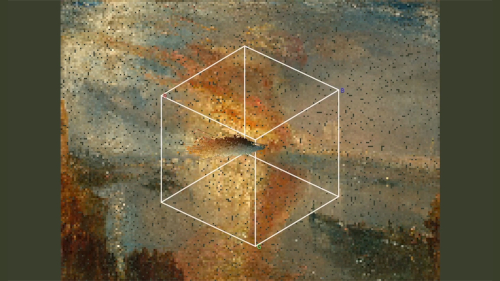
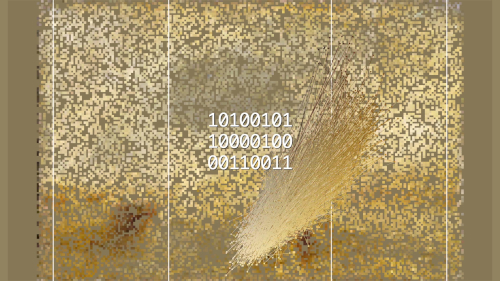
This project delves into the concept of perception and structure in the realm of digital art visualization. It employs binary code and algorithms to convey this idea. The most significant transformation of our era, from matter to data, necessitates viewing binary as a fundamental artistic medium. Kojima randomly scatters the image's pixels, dispersing all colors and replacing the original data in binary units. Since pixels consist of four binary values, the image gradually becomes fragmented, and it draws points and lines in a 3D RGB cube. Unlike computer images, which are typically programmed for immediate human recognition, this project compels viewers to witness the passage of time in binary units. The video was constructed using the aforementioned method to analyze the paintings of William Turner.
The background sound was created by converting the red, green, and blue values of each painting's pixels into a twelve-tone scale and playing them on a MIDI piano. This project deconstructs, reconstructs, and re-examines them within the modern binary system; he aims to pioneer a novel aesthetic sense in the history of art.
Show: Kenji Kojima's Biography
Hide: Kenji Kojima's Biography
Kenji Kojima was born in Japan. He moved to New York in 1980 and began his artistic career. For the first 10 years in New York City, he painted contemporary egg tempera paintings using medieval art materials and techniques. He was strongly attracted to contemporary art but felt stuck in the future of modern civilization and art with excessive material value. He tried to experience the history of the creation of the European concept of art through actual materials and techniques, that is, the history of art that is not written in literature. He was particularly interested in the basic materials of painting, such as ground, pigment, and medium, rather than the visual theme. He noticed that as society developed, people's minds expanded, materials and tools advanced, and the visual arts changed. Citibank, Hess Oil, and others have collected his egg tempera paintings.
The personal computer improved rapidly during the 1980s. He felt more comfortable with computer art than paintings. Ecologically, he had felt guilty about wasting materials in the name of art. Working on the computer was clean, did not waste material, and made him feel lighter. In the early 1990s, he moved his artwork into the digital arts. He was particularly interested in developing interactive artworks. His early digital works were archived at the New Museum - Rhizome, New York. He studied computer programming himself. In 2007, he developed the computer software "RGB MusicLab" and created an interdisciplinary artwork that explores the relationship between images and music. He developed interactive software for his art, but soon ran into a big problem. The software would not run on the new operating systems. He recorded the artwork as a video while the software ran on the operating system. This is how he started using video as a documentary tool—by filming interactive software in motion. He started making videos, not only about programming art but also about ecological issues in art. His digital art series has been shown at media art festivals worldwide, including Europe, South America, the Middle East, Asia, and the USA.
After COVID-19, he could not go out to shoot a video, but he found numerous free archival artworks online. He has started a new series that interprets classic image data using binary numbers. Artist Kojima believes that the sensory organs construct the world by extracting only certain components from the chaos, such as visual and auditory information, like a filter. So we create our world with the "key" of the sensory organs as if we were deciphering a code. In 2023, "Bitwise Splitting and Merging of Pixels" began with the self-question, "With the development of generative AI, can we create visual art that is not an assemblage of past visual data? Currently, all media is recorded in binary form. This fact leads to the manipulation of color pixels using bitwise operations. He developed encryption and decryption projects based on classic paintings, as well as a binary interpretation of paintings. He developed encryption and decryption projects based on classic paintings, which is a method for deconstructing and reinterpreting color information. As he develops his digital techniques, he prioritizes reproducibility over ownership of his works. He believes that the focus should be on the infinite dissemination of digital art, rather than its ownership and control. Kenji Kojima Resume
Hide: Kenji Kojima's Biography
 This site's videos are licensed under
Creative Commons Attribution 4.0 International License.
Credit must be given to the creator.
 Please Click and Support Kenji Kojima's Artworks.
 Scan and Donate.
日本からのドネーションはここをクリック。
日本から任意の金額のドネーションはできません。
https://kenjikojima.com/
Email: index@kenjikojima.com
|